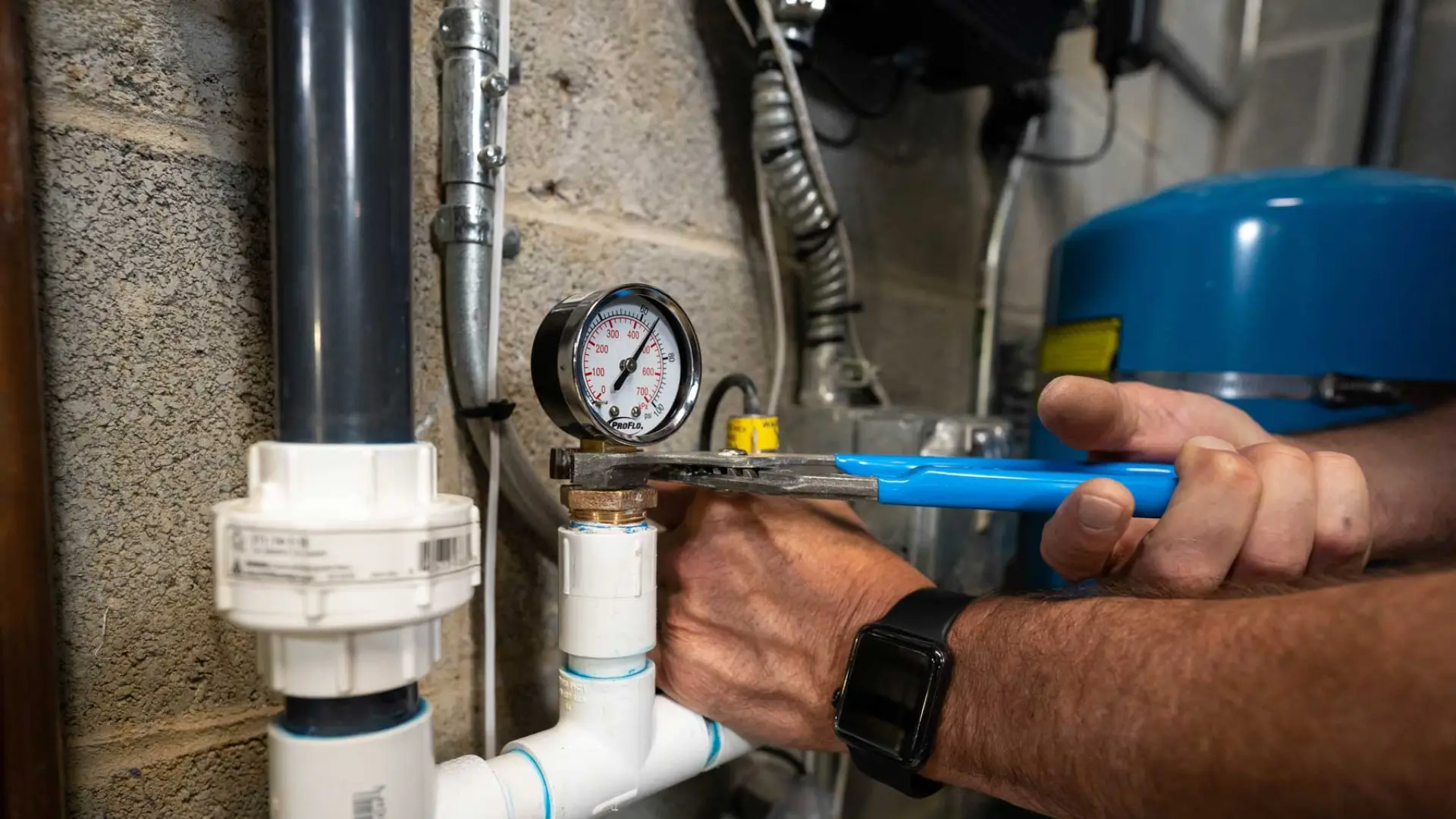
Is your shower lacking power and your kitchen faucet running slow? Low water pressure isn’t just a daily inconvenience; it’s often a symptom of an underlying issue in your plumbing system.
For homeowners on Montreal’s North Shore, this problem is common. At Plomberie A. Craig, we identify and resolve these malfunctions, whether simple or complex. Understanding the origin of the weak flow is essential to restoring optimal pressure.
This guide details the probable causes, basic diagnostics, and the right time to call a licensed professional plumber.
Table of Contents
- First Check: Local or General Problem?
- Cause #1: A Failing Pressure Reducing Valve (PRV)
- Cause #2: Limescale Buildup in Pipes and Faucets
- Cause #3: Corrosion of Galvanized Steel Pipes
- Cause #4: A Main Shut-Off Valve Mispositioned or Worn Out
- Cause #5: An Underground or Hidden Leak
- Cause #6: Clogged Faucet Aerators or Cartridges
- Cause #7: An Inadequate Piping System
- Our Professional Diagnostic Method
- DIY Troubleshooting vs. Expert Intervention
- Prevention Tips for Maintaining Good Pressure
- Frequently Asked Questions
- Conclusion: Take Action to Restore Optimal Flow
First Check: Local or General Problem?
Before any investigation, determine the extent of the problem.
Ask your neighbors. If they are also experiencing low pressure, the origin is likely municipal (work on the network, peak demand period, a main break).
Analyze the interior of your home. Does the low pressure affect:
- All water points? → Problem on the main water supply (valves, pressure reducer, supply line).
- Only hot water? → Problem related to the water heater or hot water pipes.
- Only one faucet or bathroom? → Localized problem (clogged aerator, defective faucet).
This first step guides the diagnosis and allows our Plomberie A. Craig team to intervene with a targeted strategy.
Cause #1: A Failing Pressure Reducing Valve (PRV)
🔧 Role and Symptoms
The pressure reducing valve, installed on the main water inlet, protects your installation by regulating municipal pressure (sometimes high) to a safe level (generally between 50 and 70 PSI).
Signs of a Defective PRV:
- Sudden or random pressure variation.
- Presence of water hammer (knocking in pipes).
- Visible leak at the device.
Why This Happens on the North Shore:
The lifespan of a PRV is approximately 10 to 15 years. The mineral composition of the water can clog its internal mechanism, causing it to stick in a closed or “low-pressure” position.
Our Solution:
Our plumbers measure static and dynamic pressure with a pressure gauge. If the PRV is out of service, we proceed with its replacement and precise adjustment of the pressure to guarantee performance and safety.
Cause #2: Limescale Buildup in Pipes and Faucets
🚰 The Hard Water Phenomenon
The water on the North Shore is often hard (calcareous). Over time, scale (calcium carbonate) deposits in the pipes, narrowing the water passage, akin to clogged arteries.
Main Areas Affected:
- Faucet aerators and showerheads: First elements to clog.
- Hot water pipes: Scale forms more quickly with hot water.
- Water heater tank: Sediments reduce efficiency and flow.
Characteristic Indicators:
- Gradual pressure drop over several years.
- Presence of white deposits on aerators.
- Marked difference between hot and cold water flow.
Our Solution:
Cleaning or replacing aerators. For pipes, we offer targeted hydrodynamic descaling or, if necessary, partial pipe replacement. The installation of a water softener may be recommended for severe cases.
Cause #3: Corrosion of Galvanized Steel Pipes
⚠️ A Problem in Older Constructions
Houses built before the 1970s-80s may still be equipped with galvanized steel water pipes. This material corrodes from the inside out, progressively reducing the useful diameter.
Consequences on Pressure:
Corrosion obstructs the passage, and rust flakes can travel and block downstream faucets.
Distinctive Signs:
- Pipes are silver-grey in color, and a magnet will stick to them.
- Rusty water when first opening a faucet.
- History of frequent leaks at pipe joints.
Our Solution:
An inspection with an endoscopic camera assesses the internal condition. The long-term solution is pipe replacement with modern materials (PEX, copper). It’s an investment that improves pressure, water quality, and property value.
Cause #4: A Main Shut-Off Valve Mispositioned or Worn Out
🔩 The Common Oversight
The main shut-off valve, located where the water enters the house (basement, crawl space, garage), may have been left partially closed after previous work.
How to Check:
- Locate your main shut-off valve.
- For a gate valve (wheel handle): Turn the wheel counter-clockwise as far as it will go.
- For a ball valve (lever handle): The lever must be parallel to the pipe.
Our Expertise:
Gate valves are notorious for failing over time. The internal “gate” can break or corrode in a partially closed position. If manipulating the valve doesn’t help, or if it leaks, replacement with a reliable full-port ball valve is the professional solution.
Cause #5: An Underground or Hidden Leak
💧 The Invisible Culprit
A significant leak on your water supply line between the municipal meter and your house, or a major leak inside walls or under your slab, diverts water away from your faucets.
Simple Leak Detection Test:
- Ensure no water is being used in the house. Turn off all appliances, faucets, and icemakers.
- Locate your water meter. Many modern meters in Laval and the North Shore have a small leak indicator (a triangle or wheel). If it’s spinning while everything is off, you have a leak.
- Note the meter reading, wait 1-2 hours without using water, and check again. A changed reading confirms a leak.
Our Intervention:
We use advanced electronic leak detection equipment to pinpoint the exact location of hidden leaks without destructive excavation. Once located, we can perform a targeted repair.
Cause #6: Clogged Faucet Aerators or Cartridges
🚿 The Localized Problem
If low pressure is isolated to a single sink, shower, or bathtub, the culprit is almost always on the fixture itself.
Quick DIY Diagnosis:
- For a faucet: Unscrew the aerator (screen at the spout tip). Soak it in white vinegar to dissolve mineral deposits, rinse, and reinstall.
- For a shower: Remove and soak the showerhead. Many modern showerheads also have an integrated flow restrictor that can clog.
- For a mixing valve: The internal cartridge or mixing valve can wear out or become clogged with debris.
Our Service:
If cleaning the aerator or showerhead doesn’t work, the problem is likely in the faucet’s internal valve. We efficiently replace cartridges or the entire faucet valve body to restore proper flow.
Cause #7: An Inadequate Piping System
📐 A Design Flaw from the Start
In some older homes or additions, the plumbing system may have been installed with pipes that are too small in diameter for modern demand, especially when multiple fixtures are used simultaneously.
Telling Signs:
- Pressure drops dramatically when a second faucet is opened (e.g., shower pressure drops when a toilet is flushed).
- The problem has existed since you moved in and is not a recent development.
- An addition or renovation was done without properly upgrading the main supply or branch lines.
Our Analysis:
This requires a professional assessment of your home’s water demand and the existing pipe sizing. A solution may involve replacing specific branches with larger diameter pipes or, in extreme cases, upgrading the main supply line from the street.
Our Professional Diagnostic Method
At Plomberie A. Craig, we use a systematic approach:
- Detailed Questionnaire: History of the problem, extent, recent work.
- Instrumented Measurements: Static/dynamic pressure and flow rate (GPM) with professional tools.
- Visual Inspection: PRV, valves, visible piping.
- Isolation Tests: To locate the faulty section.
- Advanced Technologies: Pipe inspection camera or acoustic detection if necessary.
This rigor ensures we treat the root cause and not just a symptom.
DIY Troubleshooting vs. Expert Intervention
✅ Safe Checks You Can Do:
- Ask your neighbors.
- Clean faucet aerators and showerheads.
- Verify the main shut-off valve is fully open.
- Perform the leak test at the water meter.
- Inspect for obvious leaks.
🚨 When to Contact Plomberie A. Craig at (438) 888-8476:
- Low pressure affects the entire house.
- You suspect galvanized pipes.
- You think there is a hidden leak or a failing PRV.
- The drop is sudden and significant.
- Your water is discolored (rust, brown).
- Your DIY checks yielded no results.
- You are uncomfortable locating or operating the main valves.
Attempting complex repairs like replacing a PRV or main valve without the proper license and tools can lead to flooding, property damage, and violations of the Quebec Building Code.
Prevention Tips for Maintaining Good Pressure
- Awareness: Know the location of your main valve and water meter.
- Simple Maintenance: Periodically descale aerators and showerheads.
- Water Softener: Consider if you have very hard water to protect installations.
- Monitor Your Water Bill: An unexplained increase in consumption can be the first sign of a hidden leak.
- Periodic Inspection: For houses over 30 years old, a periodic plumbing evaluation by a professional is wise.
Frequently Asked Questions
What is the ideal water pressure for a house?
The optimal range is between 50 and 70 PSI. Below 40 PSI, flow is generally insufficient. Above 80 PSI, the system is under excessive stress.
Is the municipality responsible?
The city is responsible for maintaining adequate pressure up to the property line. If your neighbor has good pressure and you don’t, the problem is almost always on your side of that line. However, if an entire street is affected, contact your municipal public works department.
Will a booster pump solve my problem?
A booster pump can be a solution, but only if the root cause is truly low incoming pressure from the street. It will not fix problems caused by clogged pipes, a failing PRV, or undersized piping. Always have the cause diagnosed by a professional before considering a pump.
How much does repairing low water pressure cost?
Costs vary dramatically depending on the cause:
- Cleaning an aerator: Minimal cost.
- Replacing a PRV: A few hundred dollars.
- Replacing a pipe section: Starting around $1,000.
- Complete plumbing replacement: A more significant investment. We always provide a detailed and transparent quote before any work.
Good pressure outside but low inside. Why?
This confirms the problem is within your home’s plumbing system (after the main shut-off). The likely culprits are the PRV, the main house valve, or internal restrictions.
Conclusion: Take Action to Restore Optimal Flow
Low water pressure diminishes your daily comfort and can mask more serious plumbing problems. Ignoring these signals can lead to more extensive and costly repairs later.
Plomberie A. Craig is committed to providing lasting solutions for residents of Montreal’s North Shore. Our team of licensed and insured plumbers diagnoses accurately and intervenes effectively, respecting your budget and peace of mind.
Don’t get used to insufficient pressure. 📞 Contact us at (438) 888-8476 or by email at plomberieacraig@gmail.com for a clear diagnosis and a professional solution.
This guide is for informational purposes. For any intervention on your plumbing system, always call upon a licensed and insured professional like Plomberie A. Craig, guaranteeing your safety and compliance with current standards.
Ready to Upgrade Your Plumbing System?
Plomberie A. Craig, licensed RBQ plumber (#5651-5240-01) serving St-Colomban, Blainville, Rosemère, Laval, Saint-Jérôme, Mirabel, and the entire North Shore of Montreal. Free, no-obligation estimates for renovations, leak repairs, water heater installations, and emergency plumbing.
RBQ License #5651-5240-01 | Serving residential & commercial clients since 2012