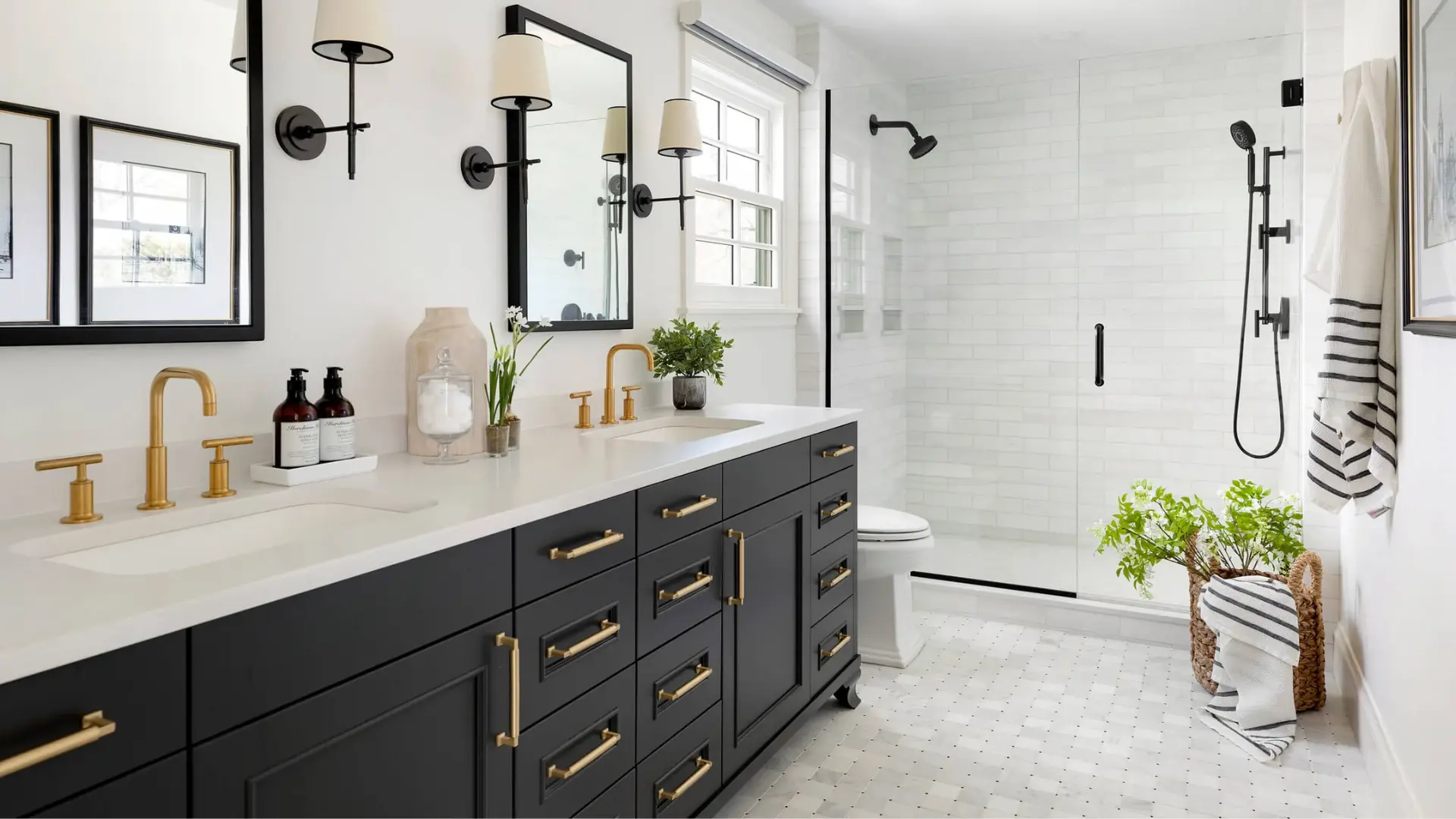
Inspired by bathroom renovations and want to modernize yours on Montreal’s North Shore? It’s a great project to revitalize your space and increase your property’s value.
However, a reality often overlooked: the infrastructure hidden behind your walls is more critical than the aesthetics of the new fixture. A designer faucet will be useless, or worse, cause damage if it’s not compatible with your existing installation.
Drawing on our experience on the North Shore, Plomberie A. Craig has witnessed the successes and costly failures of many renovations. This guide aims to provide you with practical knowledge to navigate smoothly among pipes, fittings, and standards, ensuring your dream bathroom is as functional as it is beautiful.
Table of Contents
- Fundamental Rule: What Matters is Invisible
- Pre-Purchase Checks: Ensuring Compatibility
- Focus by Fixture: Installation Expertise
- The Strategic Upgrade: Shut-Off Valves
- “Rough-In” Dimensions: The Key to Success
- Priority on Efficiency: Save Water and Money
- Realistic Budget: Cost of Professional Installation
- DIY vs. Professional: When to Call Us
- Permits and Standards: Regulations on the North Shore
- Preparing for Your Plumber’s Visit
- Frequently Asked Questions
- Our Recommendation: Plan for Success
Fundamental Rule: What Matters is Invisible
Think of plumbing as the foundation of your house. The fixtures (toilet, sink) are the finishing touches. The concealed pipes, valves, and vents are the essential structure.
The most expensive mistakes occur when choosing fixtures without understanding the existing “rough-in.”
“Rough-in” plumbing refers to the network of supply and drain pipes installed within walls and floors, with fixed outlet points.
🚨 Important to know: You must select fixtures that match your rough-in dimensions, or be prepared to undertake significant demolition and reconstruction work to move the pipes.
Pre-Purchase Checks: Ensuring Compatibility
Before purchasing anything, perform these checks. They could save you from unexpected expenses.
1. Identify Your Pipe Material
Inspect visible pipes in the basement:
- Copper: Common, durable.
- Galvanized Steel: Found in older homes (pre-1970). Prone to corrosion.
- PEX: Modern, flexible material, increasingly common.
- CPVC: Beige/yellow plastic, typical of the 1970s-90s.
2. Test Your Shut-Off Valves
Locate and operate the main shut-off valve and the individual fixture shut-off valves (under sink, behind toilet). If they are stiff to turn or leak, plan to replace them. This is essential for safety.
3. Evaluate Pressure and Flow
Low flow would ruin the experience of a new shower. Time how long it takes to fill a 5-litre bucket at the bathroom sink. If it takes more than 20 seconds, a professional diagnosis is advised before any new installation.
Focus by Fixture: Installation Expertise
🚽 Replacing a Toilet
A common task but a frequent source of leaks.
- Critical Rough-In: Distance from the finished wall to the center of the floor drain (closet flange). The standard is 305 mm (12 inches), but sometimes 254 mm or 356 mm are found in old houses.
- The Flange: The element sealed to the floor. It must be in good condition, level, and flush with the finished floor.
- Seal: Prefer a high-density wax ring or a reinforced alternative for a perfect seal.
- Water Savings: Modern models use 4.8 L/flush or less, compared to 13 L+ for old ones.
🚿 Replacing a Shower Valve or Trim
Changing a showerhead is simple. Replacing the wall valve is more complex.
- Access: Is there an access panel behind the wall? If not, a cut-out will be necessary.
- Valve Type: Choose a thermostatic or pressure-balancing valve, compliant with standards (CSA/ULC) to prevent scalding.
- Compatibility: The trim (handles, plate) is not universal. Ensure it matches the valve body.
- Pipe Condition: Opening the wall may reveal pipes that need replacing.
🪥 Installing a Sink Faucet
- Number of Holes: Your new faucet must match the pre-drilled holes in your basin or countertop (e.g., single hole, 3-hole with 102 mm center spread).
- Supply Lines (Flexibles): Always replace them. Use braided stainless steel models.
- Drain Assembly: Remember to replace the drain mechanism (often sold separately).
- Moving a Vanity: The wall drain may no longer align. A slight correction is possible with a flexible P-trap, but a large offset requires modifying the piping.
The Strategic Upgrade: Shut-Off Valves
Take advantage of the work to modernize your individual shut-off valves. Old valves (multi-turn gate valves) often seize or leak when you finally need them.
- Upgrade to 1/4-turn (ball) valves: More reliable and easier to use.
- Accessibility: Ensure they remain easily accessible after the new vanity is installed.
”Rough-In” Dimensions: The Key to Success
Here is a summary of essential measurements:
| Fixture | Critical Dimension | Explanation | Common Standard |
|---|---|---|---|
| Toilet | Flange to Wall | Distance from finished wall to center of floor drain | 305 mm (12”) |
| Bathroom Sink Faucet | Hole Spread (Center-to-Center) | Distance between centers of pre-drilled holes in basin/countertop | 102 mm (4”) or 203 mm (8”) |
| Shower Valve | Height and Depth | Height from shower floor and projection from finished wall | Height ~1220 mm (48”); Depth should be flush with wall |
| Drain Pipes | Pipe Diameter | Diameter of the drain pipe in the wall. | Sink: 32/38 mm (1.25”/1.5”); Shower/Tub: 38 mm (1.5”); Toilet: 75/100 mm (3”/4”) |
Priority on Efficiency: Save Water and Money
Modern fixtures combine performance and economy. Look for these certifications:
- WaterSense / WATERTAP (CSA): Guarantee at least 20% water savings compared to standard models.
- Regulatory Maximum Flow Rates: Faucets: 8.3 L/min (2.2 gpm); Showerheads: 7.6 L/min (2.0 gpm). These choices reduce your consumption and water heating costs.
Realistic Budget: Cost of Professional Installation
The fixture price is only part of the investment. Estimated cost for professional installation by an RBQ-licensed plumber on the North Shore:
| Scope of Work | Estimated Range (CAD) | Typically Includes |
|---|---|---|
| Simple Replacement (identical model) | $150 – $400 per fixture | Removal, installation, basic connections, testing. |
| Toilet Replacement (standard rough-in) | $250 – $500 | Removal, new wax ring, mounting, water supply connection. |
| Sink Faucet Installation (with new supply lines) | $200 – $400 | Removal, installation, connection, testing. Drain assembly not included. |
| Showerhead Change | $100 – $200 | Simple removal and installation. |
| Shower Valve Replacement (MAJOR WORK) | $900 – $2,800+ | Wall access, valve replacement, possible pipe replacements, wall patching (tiling excluded). |
| Complete Rough-In Plumbing (full renovation) | $3,000 – $7,000+ | Full installation of supply, drain, and venting systems to code, pressure testing. |
Factors Influencing Cost on the North Shore:
- Accessibility: Tight crawl spaces, finished ceilings.
- Home Age: An old installation may require updates to meet current codes.
- Fixture Complexity: High-end or imported models.
- Permit Fees: Varies by your municipality.
DIY vs. Professional: When to Call Us
| Task | DIY Potential | When to Call a Pro (RBQ Licensed) |
|---|---|---|
| Replacing a Showerhead | High – Simple screwing. | If the wall arm is damaged or leaking. |
| Replacing a Toilet (same rough-in) | Medium – Physically demanding. Risk of poor seal or damaged flange. | Recommended for a guaranteed leak-free installation. |
| Installing a New Faucet | Medium – Requires dexterity and proper connection of supply lines. | If uncomfortable, or if shut-off valves need changing. |
| Replacing a Shower/Tub Valve | None – Work on concealed plumbing, subject to code. | Always. Risk of leaks inside walls and non-compliance. |
| Moving Piping | None – Regulated and inspected work. | Always. Requires a licensed plumber for permits and code compliance. |
The Importance of the RBQ License: In Quebec, any connection to water and sewer networks must be performed by an RBQ license holder to be legal, insurable, and safe. Unauthorized work can void your home insurance and cause problems upon resale.
Permits and Standards: Regulations on the North Shore
For a simple like-for-like replacement, a permit is often not required. As soon as you modify the system (moving a drain, adding a supply line), a municipal permit is mandatory.
- Your Plumber’s Role: A licensed company like Plomberie A. Craig will handle obtaining the required permits from your municipality and scheduling inspections.
- The Inspection: It ensures compliance with the Quebec Plumbing Code, guaranteeing safety and preserving your home’s value.
Preparing for Your Plumber’s Visit
For optimal workflow:
- Clear the Area: Provide clear access under the sink, around the toilet, and the shower.
- Have Fixtures Ready: Ensure all new fixtures and parts are on-site and unpacked.
- Guarantee Access: Ensure clear access to the main shut-off valve and electrical panel.
- Establish a Plan: Clearly discuss the process with the plumber before work begins.
- Anticipate Water Shut-Off: Water will be temporarily cut off. Plan your activities accordingly.
Frequently Asked Questions
“Can I install a contemporary toilet in my old North Shore house?” Yes, but check the floor drain rough-in. Older houses sometimes have non-standard dimensions (254 mm or 356 mm). Solutions: find a model designed for that rough-in, use an offset flange adapter, or move the floor drain (more extensive work).
“My new designer faucet has very low flow. Why?” Some aesthetic faucets (waterfall, rain) have an intrinsically low flow. Check the flow rate (L/min) before purchase. An integrated flow restrictor could also be the cause.
“How long does it take to install a fixture?”
- Toilet: 1-1.5 hours
- Sink faucet: 1-2 hours
- Shower valve replacement: 1 to 2 days (including access and patching)
“Do you offer a warranty on installations?” Absolutely. A professional, licensed plumber warrants both supplied parts and labor. Always request warranty details in writing.
“I want to move my sink to another wall. Is it feasible?” It’s possible but constitutes a major renovation. It involves rerouting supply and drain lines within walls/floors, requiring demolition, permits, inspections, and patching. The cost and complexity are far greater than a simple replacement.
Our Recommendation: Plan for Success
Modernizing your bathroom should be a rewarding project. The key to success lies in meticulous preparation and partnership with professionals.
- Study the Existing Setup: Take photos, measure scrupulously, identify your pipes.
- Priority on Compatibility/Quality: Choose fixtures from reputable brands, compatible with your installation. Function trumps fleeting trends.
- Seek Professional Advice: For any project beyond simple replacement, consult a licensed plumber before making purchases. Plomberie A. Craig offers consultations to guide your choices and provide a transparent quote.
- Value Code-Compliant Installation: The most beautiful piece is only as good as its installation. Code-compliant work prevents leaks, protects your home, and ensures a long lifespan.
Your renovated bathroom is within reach. By combining your vision with the expertise of a licensed plumber, you’ll create a space that blends aesthetics with lasting performance.
This guide is provided for informational purposes by Plomberie A. Craig, holder of an RBQ license. It does not substitute for an on-site assessment. All plumbing work must comply with the Quebec Construction Code and municipal regulations. For a consultation regarding your project on Montreal’s North Shore, contact us at (438) 888-8476 or by email at plomberieacraig@gmail.com.
Ready to Upgrade Your Plumbing System?
Plomberie A. Craig, licensed RBQ plumber (#5651-5240-01) serving St-Colomban, Blainville, Rosemère, Laval, Saint-Jérôme, Mirabel, and the entire North Shore of Montreal. Free, no-obligation estimates for renovations, leak repairs, water heater installations, and emergency plumbing.
RBQ License #5651-5240-01 | Serving residential & commercial clients since 2012